Kotlin app / Android
Automata & Compiler Studio.
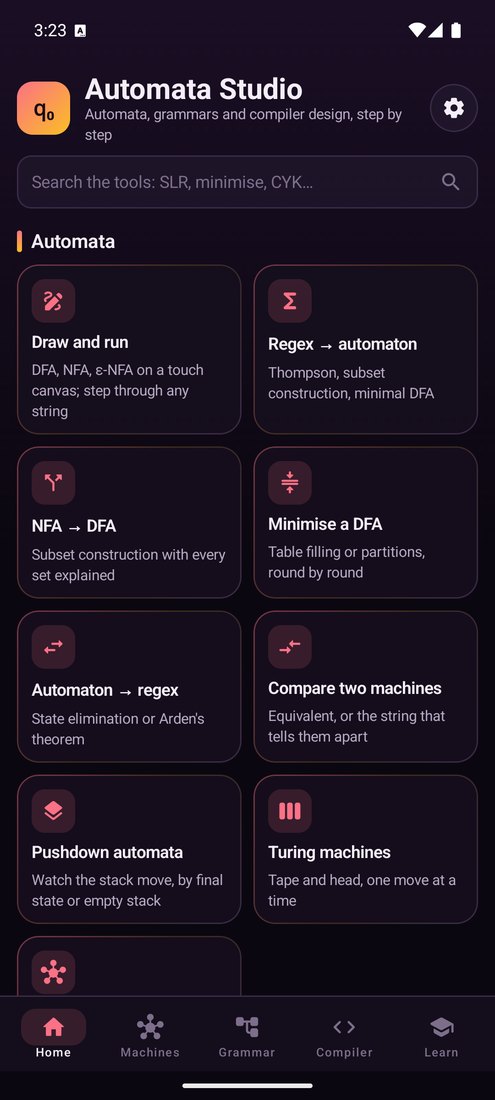
A workbench for students of Theory of Computation and Compiler Design. Draw a machine or type a grammar, and the app works the problem the way a textbook does: the answer first, then the method step by step in plain words.
Coming soon to Google Play.
Screenshots
What you get
Draw on a touch canvas
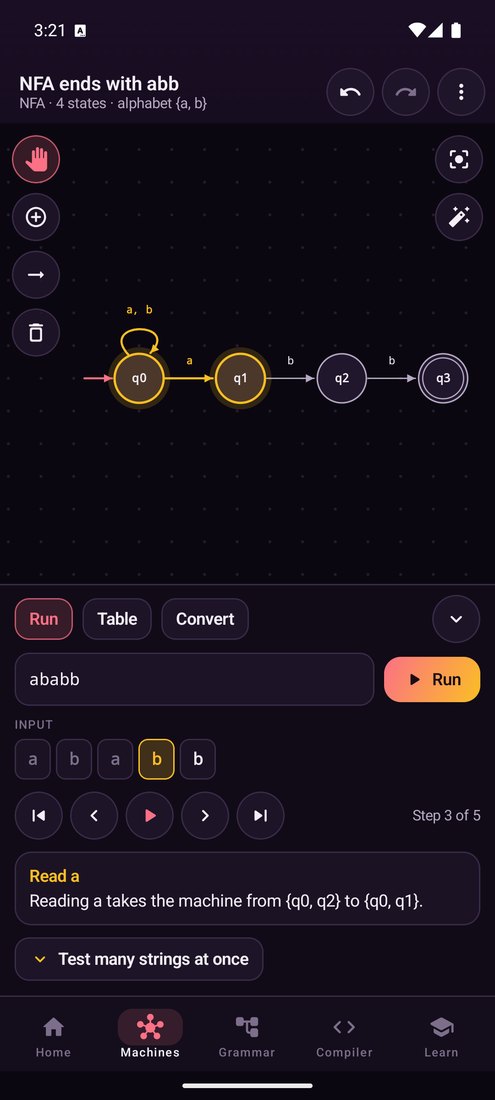
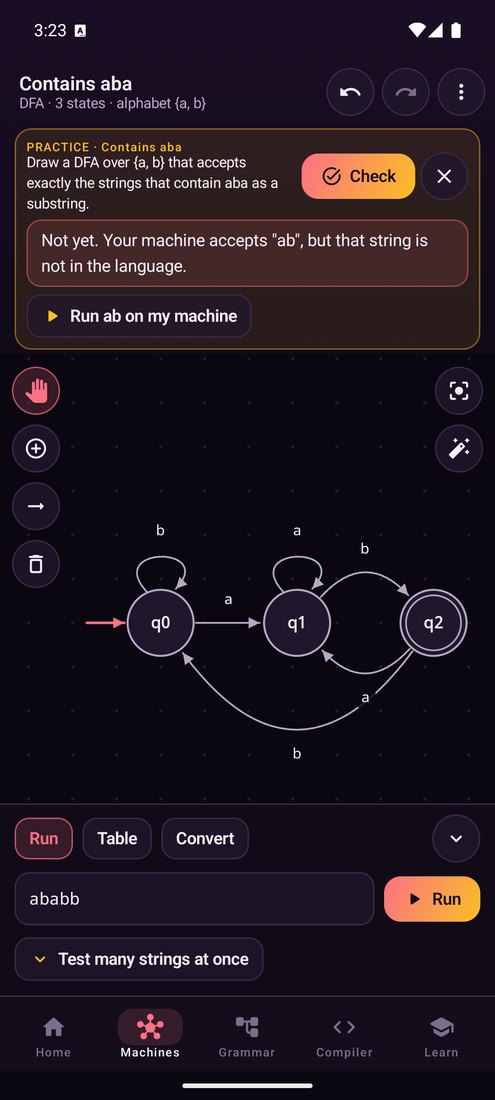
DFA, NFA and ε-NFA, pushdown automata, Turing machines, and Mealy and Moore machines. Tap to add states, drag to connect, pick symbols from chips.
Run and step, forwards and back
See which states are active after every symbol, the stack of a pushdown automaton and the tape of a Turing machine, and why the string was accepted or rejected.
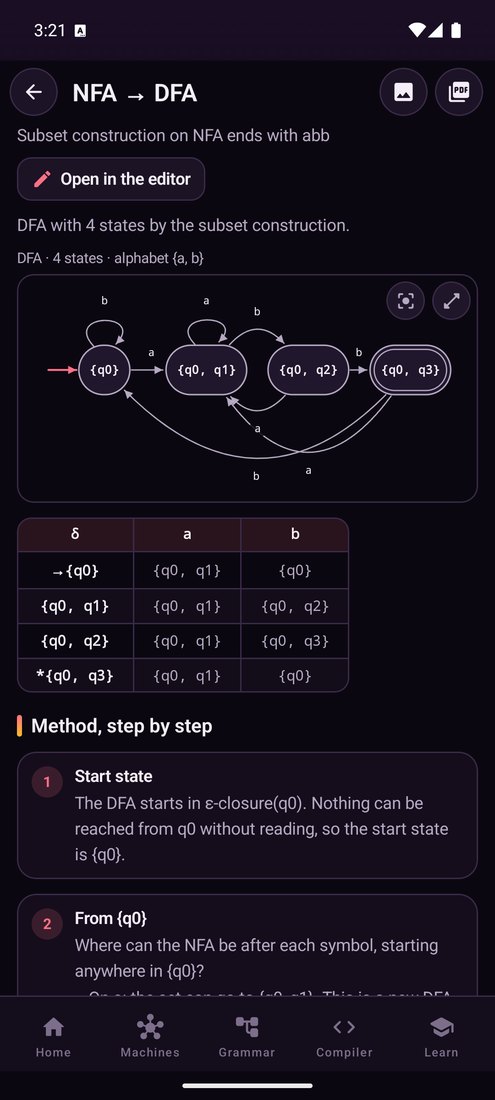
Conversions, each explained
NFA to DFA, removing ε-moves, minimisation by table filling or by partitions, regular expressions both ways, complement, union and intersection.
Are two machines the same?
An equivalence check that answers yes, or gives the shortest string one accepts and the other rejects.
Your own grammar
Useless symbols, ε-productions and unit productions, Chomsky normal form, the CYK table, derivations and parse trees, with a second tree when a string is ambiguous.
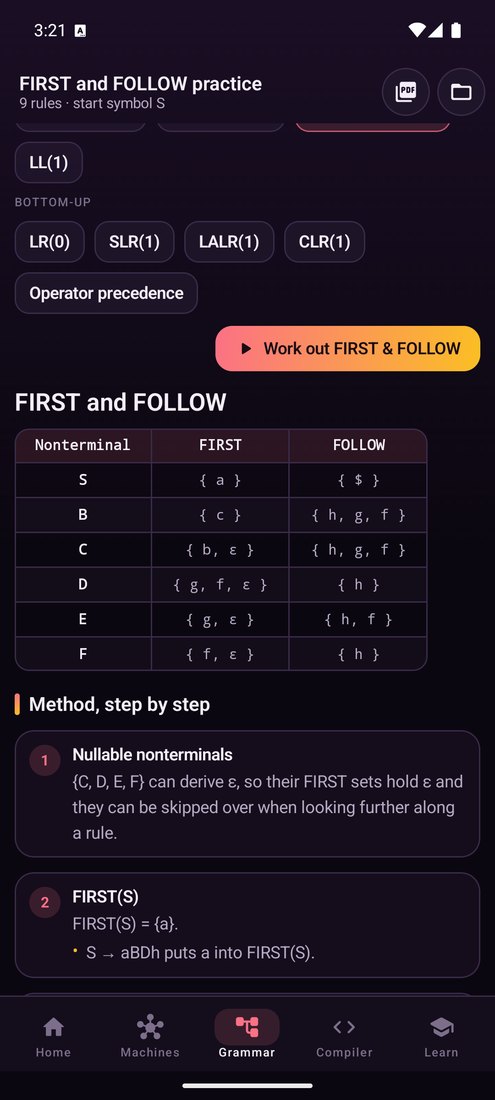
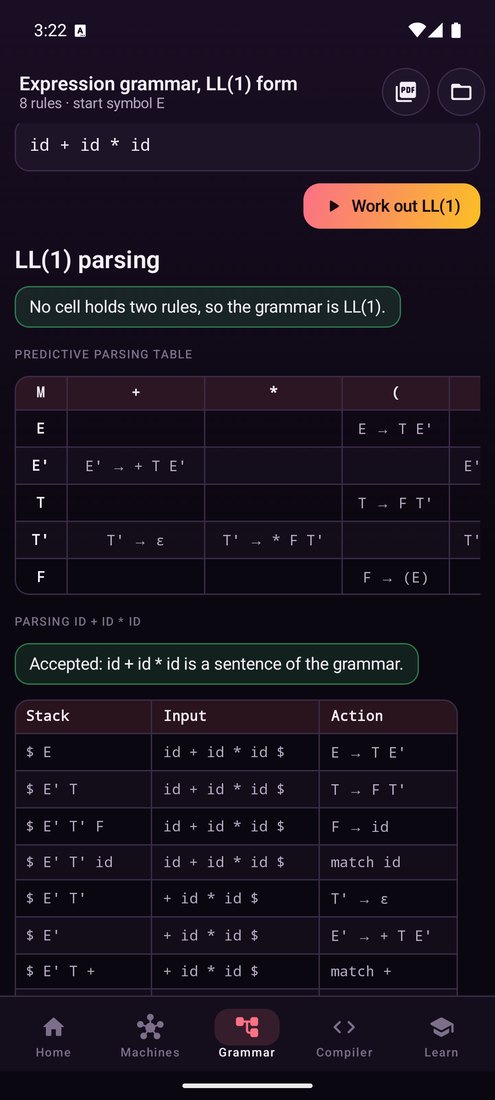
FIRST, FOLLOW and LL(1)
Left recursion and left factoring, the sets with the rule behind every symbol, the predictive parsing table and a parse trace.
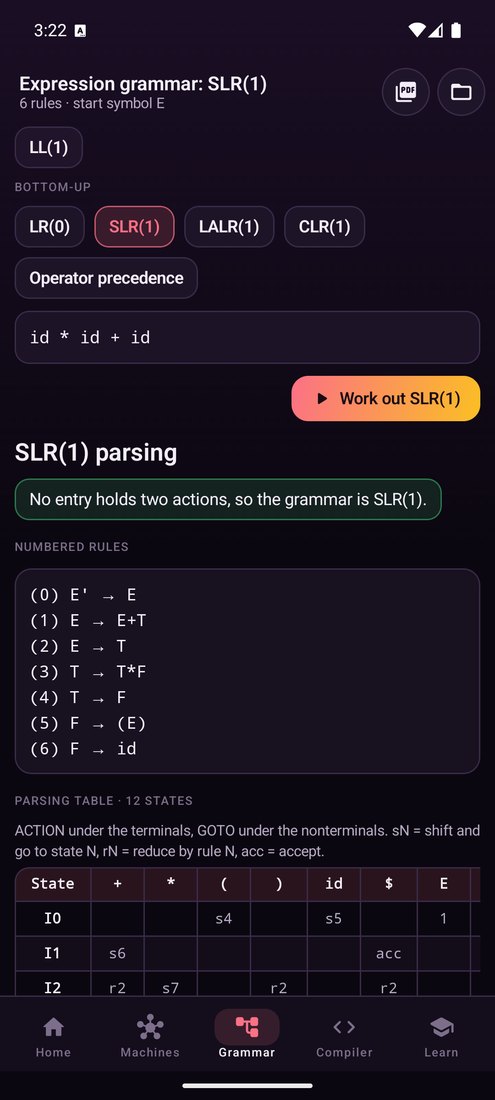
LR(0), SLR(1), LALR(1), CLR(1)
Item sets, the automaton, ACTION and GOTO tables, and every conflict explained with the items that clash.
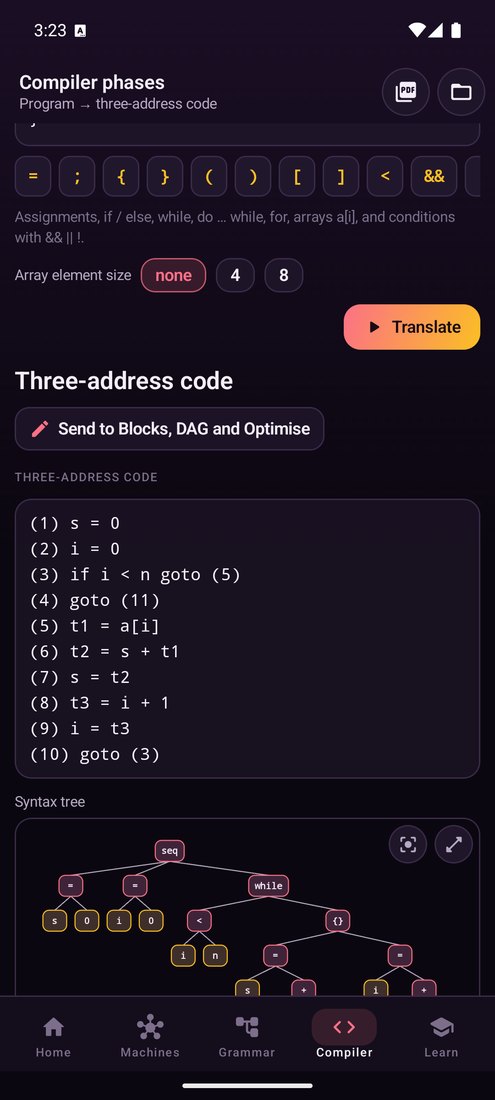
Compiler phases
A lexer from your token rules, three-address code with quadruples and triples, basic blocks and the flow graph, the DAG of a block, and local optimisations.
Examples and checked practice
47 worked examples from the usual textbooks, and 60 problems where your own machine, expression, grammar or sets are checked.
Ready for assignments
Share a diagram as a picture or a whole worked solution as a PDF, and open and save JFLAP files.
Made to be right, and to show its working
Every explanation in the app is written by the algorithm that did the work, at the moment it did it, so a step can only say what really happened. The algorithms are checked against the well-known textbook results, and against each other on thousands of generated cases: an NFA, its DFA and its minimal DFA must accept the same strings, and every parser must agree with the others.
It works offline and needs no account. What you draw and type is kept on your device. Every tool is free; the app shows a small banner advert on result and Learn screens, never over your drawing, and a one-time purchase removes it.
Not in this version: multi-tape Turing machines, the pumping lemma, Greibach normal form and syntax-directed translation. If an answer ever disagrees with your textbook, write to [email protected] and tell me which.